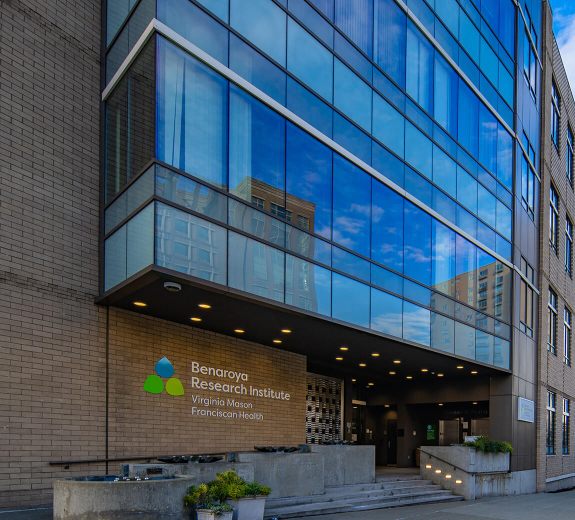
Benaroya Research Institute (BRI) graduate student, Izzy Draper, and postdoctoral researcher, Hayley Waterman, PhD, were recently awarded competitive fellowships that recognize their innovative research aimed at understanding immune cell function in autoimmune diseases like systemic lupus erythematosus (SLE). Ms. Draper and Dr. Waterman were selected for their outstanding proposals to address fundamental questions in immune tolerance with direct implications for improving health in patients with SLE.
Izzy Draper was awarded the Cell and Molecular Biology Training Fellowship through University of Washington, funded by the National Institutes of Health (NIH), to support her work as a PhD candidate in the Campbell Lab, identifying novel mechanisms of dysregulated immune tolerance in SLE. Her research focuses on the interaction between regulatory T cells (Tregs) and autoreactive B cells, and how Tregs fail to impart tolerance through B cell suppression due to increased inflammation characteristic of SLE.
A hallmark of SLE is autoreactive B cells, which produce antibodies that attack healthy tissue and cause widespread tissue damage. Tregs can suppress autoreactive B cells, but due to elevated inflammation in SLE, this mechanism of tolerance is believed to be impaired. Ms. Draper will mechanistically map Treg suppressive function of B cells and how inflammatory signals change this function to determine how autoreactive B cells escape Treg-directed suppression in SLE. By integrating genetic and functional techniques with patient samples, her work aims to identify novel mechanisms of Treg-mediated suppression of B cells and better understand what causes SLE.
“Although there are successful treatments that deplete B cells, they don’t address the underlying conditions that cause SLE,” said Ms. Draper. “Our goal is to tease out the effects of SLE-driven inflammation on Treg suppressive function and link it to autoreactive B cell escape from tolerance so that we can develop new targets for therapeutic intervention.”
Dr. Waterman, a postdoctoral fellow in the Hamerman Lab, was awarded the Rheumatology Training Fellowship through University of Washington to investigate specific autoreactive B cells against the autoantigen Smith ribonucleoprotein (Sm/RNP), which are associated with more severe SLE and disease-associated nephritis.
In collaboration with Dr. Oliver Harrison’s lab at BRI, the Hamerman Lab has generated novel B cell tetramers, a technology that detects antigen-specific B cells, to aid in the study of Sm/RNP-specific autoreactive B cells. Dr. Waterman plans to deeply profile these cells using B cell tetramers and RNA-sequencing analysis to determine what is different about them compared to B cells in healthy individuals or B cells that respond to a pathogen, like influenza. This work will not only help us understand the disease mechanisms of SLE but also may lead to the identification of new therapeutic targets.
“Interestingly, we have found that healthy individuals have similar rates of Sm/RNP-specific B cells to SLE patients, suggesting that there is a quality, not quantity, difference in the B cells that drive SLE” said Dr. Waterman. “This finding highlights the importance of my work in understanding what drives these autoreactive B cells to cause disease in SLE patients.”
“Ms. Draper and Dr. Waterman are tackling important questions that are crucial to the understanding of what causes disease in SLE patients,” said Jessica Hamerman, PhD, Director of Academic Affairs at BRI. “Training fellowships like the Cell and Molecular Biology and Rheumatology Fellowships through UW allow our early-career scientists to conduct complex research while also receiving professional training that will advance their careers in the field of autoimmunity.”
Together, their research reflects BRI’s commitment to advancing the science of the human immune system and how the research being done at BRI is synergistic, leading to a better understanding of autoimmunity.
For more information about BRI, visit www.benaroyaresearch.org.