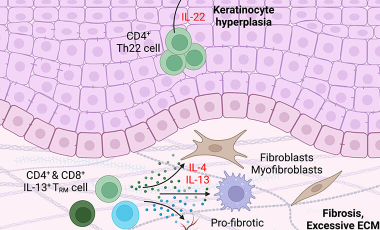
Fibroblasts are essential for maintaining the structure and function of healthy skin, but their dysregulation can drive the progressive fibrosis characteristic of scleroderma. Using spatial transcriptomics, the Morawski Lab has identified distinct fibroblast states across healthy, clinically uninvolved, and affected skin, providing evidence that dysregulation may begin before fibrosis becomes clinically apparent.
These findings suggest that clinically uninvolved skin may contain an early, transitional fibroblast state in which programs that normally maintain healthy tissue are destabilized before these cells become committed to fibrosis. Researchers are investigating the signals required to maintain healthy fibroblast states and what drives these cells from early dysregulation to irreversible fibrotic commitment.
By defining these early changes, the team aims to better understand how this dysregulation develops and ultimately contributes to fibrosis in scleroderma.