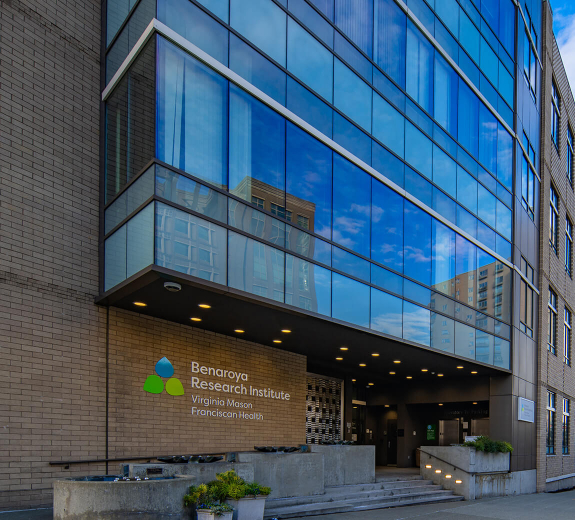
Benaroya Research Institute (BRI) announced 18 research grants, totaling over 16.2 million dollars, awarded in the first half of 2026.
A $4.4 million grant will support research into how commensal-specific T cell responses contribute to immune tolerance in health and disease. Led by BRI scientist Oliver Harrison, DPhil, this work will elucidate the role of commensal-specific CD8+ T cell dysregulation in diseases of the gut, like inflammatory bowel disease (IBD). This project, focused on identifying the immunological, cellular and tissue factors that contribute to dysregulation of commensal-specific CD8+ T cells and cause inflammation, is novel and has potential for identifying new therapies.
Sponsor: National Institutes of Health (1R01AI199097-01).
Another grant awarded $4.4 million to BRI investigators Alice Long, PhD, Estelle Bettelli, PhD, and Daniel Campbell, PhD, supports the study of a promising treatment for type 1 diabetes (T1D), known as polyclonal autologous in vitro-expanded regulatory T cells (expTreg), and how to improve clinical outcomes with this treatment. ExpTreg show differential clinical effects depending on their genetic signature and metabolic state, and BRI researchers believe that understanding these intrinsic features may lead to the next generation of Treg therapies that are tailored to an individual.
Sponsor: National Institutes of Health (1R01AI193642-01A1).
Eddie James, PhD, received a grant amounting to $2.6 million in support of studying the dynamic neoepitope repertoire of CD4+ T cells in the context of T1D onset. It is believed that beta cell injury, which leads to the development of T1D, also elicits neo-epitope formation and thus an evolving autoreactive T cell response. The James Lab will study this shift in CD4+ T cells in at-risk individuals before and after the appearance of new autoantibodies in order to advance the understanding of autoimmune disease progression.
Sponsor: National Institutes of Health (1R01AI196517-01).
Dr. James additionally received two grants from Breakthrough T1D, totaling 1.1 million, to study factors that influence the fitness of replacement beta cells, and one grant from the Cystic Fibrosis Foundation (CFF) to study autoreactive T cells and novel autoantibody profiles in the context of cystic fibrosis.
Sponsor: Breakthrough T1D (3-SRA-2026-1896-S-B; 3-SRA-2026-1803-S-B), Cystic Fibrosis Foundation (0099561225)
In addition to these awards, BRI team members received 12 other grants supporting new and ongoing projects:
- Dissecting how DYRK1A-gp130 axis drives immune dysregulation in Down Syndrome and beyond, Bernard Khor, MD, PhD. Amount: $496,344. Sponsor: National Institutes of Health, National Institute of Allergy and Infectious Diseases
- Inhibiting CNS resident memory T cells driving neuroinflammation, Estelle Bettelli, PhD. Amount: $489,500. Sponsor: National Institutes of Health
- Circulating and Mucosal Predictors and Effects of Therapeutic Interleukin-23 Blockade in Crohn’s Disease, James Lord, MD, PhD. Amount: $489,500. Sponsor: National Institutes of Health, National Institute of Allergy and Infectious Diseases
- Reprogramming of tissue structural cells by cutaneous CD4+ T cells, Daniel Campbell, PhD. Amount: $349,974. Sponsor: National Institutes of Health
- Platforms for Cross-Therapeutic Profiling and Mechanistic Studies of Immune-Modifying Therapies in Type 1 Diabetes, Daniel Campbell, PhD. Amount: $1,045,621.50. Sponsor: Breakthrough T1D
- EP665: REVEAL Clustering—Bioinformatics Support, Charlie Quinn. Amount: $16,730. Sponsor: National Institutes of Health, National Institute of Allergy and Infectious Diseases
- EP647: CITEseq of CD8 T cells in REVEAL, Alice Wiedeman. Amount: $374,735. Sponsor: National Institutes of Health
- EP666: REVEAL Genotyping, Karen Cerosaletti, PhD. Amount: $18,770. Sponsor: National Institutes of Health, National Institute of Allergy and Infectious Diseases
- EP638: Impact of dual target desensitization treatment on memory B cells, Antibody and non-Antibody, Alice Long, PhD. Amount: $116,898. Sponsor: National Institutes of Health
- Machine learning-enabled design of prototype pathogen vaccines and antibodies, Oliver Harrison, DPhil. Amount: $79,607. Sponsor: National Institutes of Health
- Uehara Memorial Foundation Grant, Jane Buckner, MD. Amount: $35,178.09. Sponsor: Uehara Memorial Foundation
For more information about BRI, visit www.benaroyaresearch.org.
This press release was developed with assistance from Microsoft Copilot (version 1.25121.69.0).