
Antibodies do two things at once. Their variable (Fab) domain recognizes a target, while their constant (Fc) domain interacts with a complex network of Fc-receptors to determine how the immune system responds. Engineering the Fc is thus a powerful way to control immune responses. In practice, however, achieving that control is difficult.
Different Fc-receptors bind highly overlapping surfaces on the Fc, so it is challenging to tune one interaction without unintentionally changing several others. As a result, isolating even a handful of variants with altered binding to one or two receptors has traditionally taken months to years of experimental screening.
We reasoned that if Fc-receptor engagement could be measured at sufficient scale, artificial intelligence (AI) models could learn the rules connecting Fc sequence to receptor binding directly from experimental data. Hence, we built a library containing hundreds of millions of synthetic antibody Fc-variants, sorted it against a panel of Fc-receptors to isolate binding and non-binding populations for each, and sequenced the resulting populations to create a large-scale atlas of Fc sequence-function relationships.
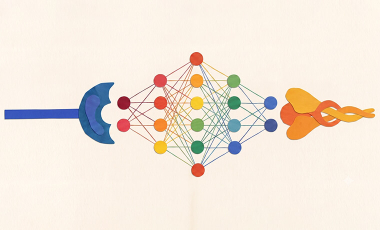
These data enabled us to develop FcGPT, a protein language model built specifically for Fc biology. While AI has increasingly been used to design antibody Fab domains to optimize target recognition, FcGPT extends that logic to the Fc, enabling independent tuning of binding across receptors whose sites overlap – a multi-objective design problem that has remained intractable for structure-guided and directed evolution approaches. With FcGPT, we can simply specify a desired combination of receptor interactions, and the model will computationally design novel Fc sequences predicted to produce it, collapsing years of experimental screening into minutes of in silico generation.
The lab is now extending this work to uncover the rules that govern how Fc sequence shapes Fc-receptor binding and immune function, and to design antibodies that direct immune responses with greater precision.