


Why Individual Contributions Matter More Than You’d Expect
If you’ve ever donated to a cause you care about, you may have found yourself wondering about how much of an impact your contribution made. You may be surprised to learn that individual contributions are actually the most powerful support mechanism for nonprofits to continue doing great work. According to Giving USA’s annual report, giving by individuals accounted for 75 percent of charitable donations in 2016 – compared to just 5 percent from big corporations.
This is good news if you’re looking for a way to make a difference in 2018 and beyond. And if you’re particularly interested in supporting scientific research, a donation to BRI could be a great place to start.
Here at BRI, individual support is critical to the advancement of groundbreaking research on autoimmune disease and allergies causes, treatments and cures.
Private donations to our Innovation Fund – which make up roughly 10% of our annual funding – offer our researchers the chance to test new ideas and gather data to prove their potential, ultimately attracting larger-scale funding. Take Erik Wambre, PhD, who with initial support from this fund made a key discovery regarding the cause of allergies.
10% may not seem like a lot, but the dollars can grow: For every $1 donated, BRI is able to obtain $6 in additional support for the development of life-changing clinical treatments and cures. Following his preliminary breakthrough, Dr. Wambre received $2.2 million in federal funding and was ultimately able to identify a unique biomarker that initiates and drives allergies.
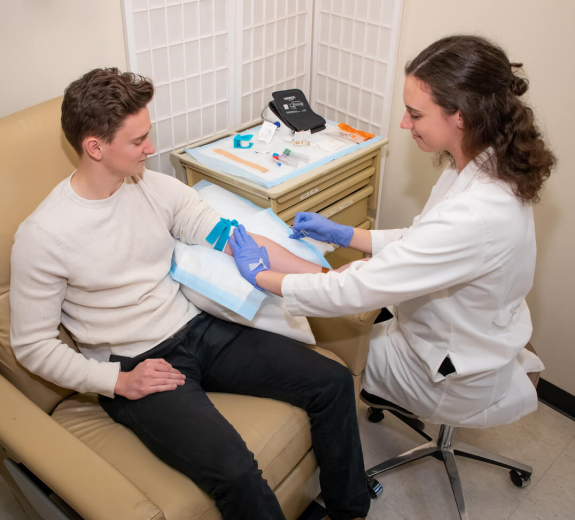
While funding is hugely important, scientific organizations like ours are also looking for donations of blood or tissue to drive innovation. These biological contributions are some of the simplest and most effective donations an individual can make. One great way to do this is through a biorepository, which is a bank of samples and health histories that support scientific research on a wide variety of diseases.
At BRI, we utilize a slew of biorepository resources to study autoimmune disorders, with more than 250,000 samples from 10,000 patients – both sick and healthy – dating back almost two decades. These volunteer participants have contributed to significant progress across the board: from improving diagnosis and treatment for allergies, to reversing some of the damage caused by multiple sclerosis.
So how do I get started?
Whether you’re interested in giving blood or money, we’re eager to hear from you. Remember: a little can go a long way – and it’s always the right time to get started.
To make an individual donation to BRI’s research on autoimmune diseases and allergies, visit our donations page or email donations.virginiamason@commonspirit.org. If you’re intrigued about joining our biorepository, learn more and sign up.
You Might Also Like
Innovation Fund Spotlight: New Tool Enables Scientists to Collect More Data From Rare Cells
Scientists know that cells of the immune system attack healthy tissue in autoimmune disease. But they don’t know exactly when those cells go awry, what drives them toward disease or if that process can be slowed or stopped to prevent disease. BRI has been instrumental in research that led to the first medicine to delay the onset of type 1 diabetes. Now, Peter Morawski, PhD, and Arpit Mishra, PhD, are building on that work and exploring early intervention in other autoimmune diseases.
Innovation Fund Spotlight: Finding the Precise Moment When Immune Cells Start Causing Disease
Autoimmune diseases happen when immune cells, which are supposed to protect you from germs, mistakenly attack healthy tissues. But what if we knew exactly which immune cells would attack – and when? Could we stop that attack before it starts? BRI’s John Ray, PhD, and Oliver Harrison, DPhil, are exploring exactly that.
Innovation Fund Spotlight: Pioneering a New Generation of Tetramers
In the late 1990s, Bill Kwok, PhD, pioneered MHC class II tetramers, a game-changing tool in immunology research. Tetramers have fueled countless research breakthroughs because they enable scientists to find extremely rare cells and extract them to study in precise detail.
Immuno-what? Hear the latest from BRI
Keep up to date on our latest research, new clinical trials and exciting publications.