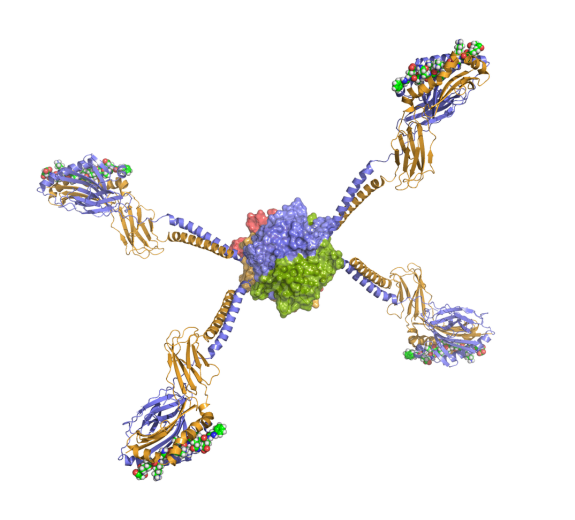
Dr. Kwok and Eddie James, PhD, have been developing a new iteration of tetramers, called second generation tetramers, ever since. They recently earned an Innovation Fund grant to support this work.
“We talked about second generation tetramers at an international immunology meeting, and it generated a lot of enthusiasm," Dr. James said. “I’ve had several investigators call and say, ‘When can I try this?'"
Tell us more about your project. What is your team hoping to learn?
Dr. Kwok: We hope to use the Innovation Fund grant to continue developing second generation tetramers and use them to study the most important T cells in autoimmunity.
Dr. James: For years, we’ve wondered about the role low-affinity T cells play in autoimmune diseases like type 1 diabetes (T1D). My dream is to understand whether low-affinity cells are central to causing disease, or if high and low-affinity cells play different but complementary roles in causing disease.
How will you use this tool?
Dr. James: One key project is using second generation tetramers to study changes in T cells in the earliest stages of T1D, before a person develops symptoms. Down the road, this could help us interfere with that process and stop T1D before it starts.
Dr. Kwok: I’ve been interested in the role of low-affinity cells in multiple sclerosis for 20 years but never had the tool to effectively find and study them. So, I’d like to do that. There are also potential applications beyond autoimmune diseases, including:
- Finding and studying previously hard-to-detect T cells that play a role in cancer.
- Understanding how the immune cells generated by previous infections or vaccinations could help protect people from new virus variants.
How do Innovation Fund grants advance research at BRI?
Dr. James: Philanthropy plays a crucial role in funding the development of tools and technologies because the NIH doesn’t typically fund that type of work. And we need these tools — and preliminary data showing that they work — to apply for larger grants.
I actually applied for a grant to study early cell changes in T1D years ago. But we didn’t get the grant because funders said we would not be able to collect and study enough cells to find meaningful answers. I reapplied earlier this year with evidence that second generation tetramers could collect up to 10 times as many disease-causing cells — and received $2.6 million in funding from the NIH.
Dr. Kwok: Eddie said it all. The Innovation Fund powers important progress at BRI, and I can’t thank donors enough for their support.
Learn more
Read about other Innovation Fund projects:
Consider making a donation to support BRI’s Innovation Fund.