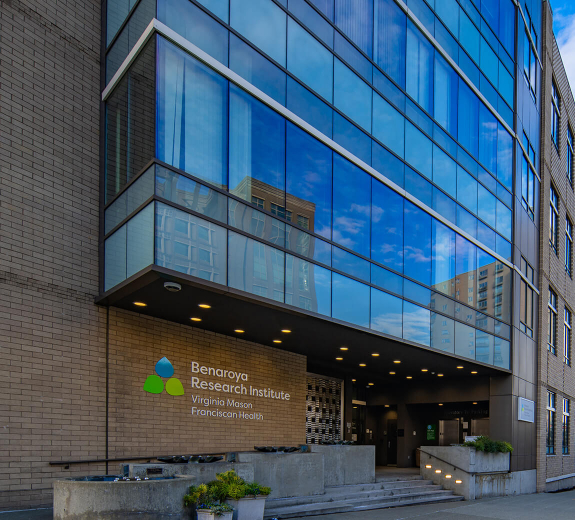
Benaroya Research Institute (BRI) postdoctoral researchers, Sheenam Verma, PhD, and Sarah Kobernat, PhD, were recently awarded competitive fellowships that recognize their innovative research aimed at advancing the understanding of immune function in infectious and autoimmune diseases. Drs. Verma and Kobernat were selected for their outstanding proposals to address fundamental questions in immunology with direct implications for improving human health.
Dr. Verma was awarded the ReVAMPP Center Early-Stage Investigator Program Fellowship to support her work as a postdoctoral fellow in the Harrison Lab, defining how vaccine design variables — specifically immunization route and antigen formulation — shape long-term protective immune responses. Her research focuses on B cell responses, which are essential for generating durable antibody-mediated immunity.
Vaccines remain one of the most effective tools in public health, yet critical gaps remain in understanding how different delivery strategies influence the quality and persistence of immune protection. Dr. Verma will systematically compare vaccine platforms and routes of administration to determine how they affect the magnitude, durability, and tissue localization of memory B cells and antibody-secreting cells.
By integrating advanced immunological techniques with novel vaccine candidates, her work aims to inform the rational design of next-generation vaccines capable of providing broader and longer-lasting protection against emerging infectious diseases.
“Understanding how to generate durable, protective immune responses is central to improving vaccines,” said Dr. Verma. “Our goal is to identify strategies that can enhance immunity against high-priority pathogens and better prepare us for future pandemics.”
Dr. Kobernat, a postdoctoral fellow in the Long Lab, was awarded an American Diabetes Association fellowship to investigate how a widely used class of metabolic drugs — glucagon-like peptide-1 receptor agonists (GLP-1s) — may influence immune responses in autoimmune disease.
Originally developed to treat type 2 diabetes and obesity, GLP-1 therapies have recently been associated with improvements in autoimmune disease symptoms, prompting new questions about their broader biological effects. Dr. Kobernat’s research will explore how these drugs alter immune cell metabolism and whether they can shift the balance between inflammatory effector T cells and regulatory T cells, which play a critical role in controlling autoimmune responses.
“We hope to better understand how these medications interact with the immune system in both type 1 and type 2 diabetes,” said Dr. Kobernat. “If GLP-1s can modulate the cells driving autoimmunity, they may have therapeutic potential beyond their current use.”
“These fellowships highlight the exceptional talent of early-career investigators at BRI,” said Jane Buckner, MD, President of BRI. “Drs. Kobernat and Verma are tackling important and complex questions that have the potential to transform how we treat autoimmune diseases and design effective vaccines.” Together, their research reflects BRI’s commitment to advancing the science of the human immune system and translating discoveries into meaningful improvements in patient care.
For more information about BRI, visit www.benaroyaresearch.org.
This press release was developed with assistance from OpenAI’s ChatGPT (version 5.3).